
Scientific Outputs
Articles
“Eclipse in Press: The circulation of news about the 1919 Total Solar Eclipse.”
Ana Simões, Luís Miguel Carolino, Cristina Luís, Samuel Gessner, Hugo Soares. Media History, in press, 2026
History of Science
Eclipse on Paper: The 1919 Total Solar Eclipse in Brazilian newspapers
Ana Simões, Luís Miguel Carolino
Abstract
The 1919 total solar eclipse was a natural event of great mobilization in Brazil. The national scientific community used the occasion to advance astrophysical knowledge about the Sun and establish its scientific credentials within the international community; the political elite seized the opportunity to project an image of Brazil’s modernity abroad; and a large audience turned to newspapers to engage with the eclipse.
Newspapers provided a wealth of eclipse-related information, updating readers on the arrival of scientists in northeast Brazil, their journeys to Sobral (the second city of the state of Ceará, where Brazilian, American, and British teams were to observe totality), on the logistics involved, and on their different observational agendas, including the British team’s test of Einstein’s prediction of light bending.
In this article, we offer an analysis of the 1919 eclipse coverage across Brazilian newspapers at national, state, regional, and local levels, published respectively at the cities of Rio de Janeiro, Belém do Pará, Camocim, and Sobral, to reveal how much locality shaped the contents and styles of news. The presence of foreign astronomers meant the scientific dimensions of the eclipse took the lead in Sobral’s and Camocim’s newspapers, while religious and social dimensions were also evidenced, with emphasis on the Catholicism of the British astronomers. In the states of Pará and Rio de Janeiro, the social and political appropriations of the eclipse, often with satirical overtones, took pride of place.
Pages: | DOI: https://doi.org/10.1080/13688804.2026.2684739 | 2026
“Eclipse on Paper: The 1919 Total Solar Eclipse in Brazilian newspapers.”
Ana Simões, Luís Miguel Carolino. History of Science, 2026
History of Science
Eclipse on Paper: The 1919 Total Solar Eclipse in Brazilian newspapers
Ana Simões, Luís Miguel Carolino
Abstract
The 1919 total solar eclipse was a natural event of great mobilization in Brazil. The national scientific community used the occasion to advance astrophysical knowledge about the Sun and establish its scientific credentials within the international community; the political elite seized the opportunity to project an image of Brazil’s modernity abroad; and a large audience turned to newspapers to engage with the eclipse.
Newspapers provided a wealth of eclipse-related information, updating readers on the arrival of scientists in northeast Brazil, their journeys to Sobral (the second city of the state of Ceará, where Brazilian, American, and British teams were to observe totality), on the logistics involved, and on their different observational agendas, including the British team’s test of Einstein’s prediction of light bending.
In this article, we offer an analysis of the 1919 eclipse coverage across Brazilian newspapers at national, state, regional, and local levels, published respectively at the cities of Rio de Janeiro, Belém do Pará, Camocim, and Sobral, to reveal how much locality shaped the contents and styles of news. The presence of foreign astronomers meant the scientific dimensions of the eclipse took the lead in Sobral’s and Camocim’s newspapers, while religious and social dimensions were also evidenced, with emphasis on the Catholicism of the British astronomers. In the states of Pará and Rio de Janeiro, the social and political appropriations of the eclipse, often with satirical overtones, took pride of place.
Pages: | DOI: 10.1177/0073275326141960 | 2026
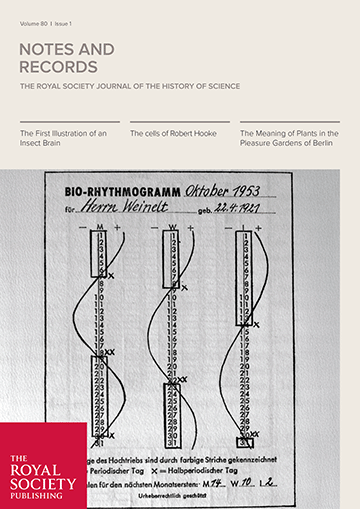
“The 1919 Total Solar Eclipse: Light and Shadow over Edwin Turner Cottingham.”
Hugo Soares. Notes and Records of the Royal Society, 2026
Notes and Records of the Royal Society
The 1919 Total Solar Eclipse: Light and Shadow over Edwin Turner Cottingham
Hugo Soares
Abstract
The observations made during the 1919 total solar eclipse by the two British expeditions which observed totality in the city of Sobral in Brazil and in Príncipe, a small island in the Gulf of Guinea, then part of the Portuguese colonial empire, provided an opportunity to test one of the three astronomical predictions in the general relativity theory put forward by Albert Einstein in 1915: the deflection of light due to the Sun’s gravitational field. The Sobral expedition included two astronomers from Greenwich Observatory—Charles Rundle Davidson and Andrew Claude Crommelin; the expedition, which observed in Príncipe, included the astrophysicist Arthur Stanley Eddington, and the clockmaker and precision time expert Edwin Turner Cottingham. This article will focus on Cottingham, the most overlooked of the four observers. His participation and role in the 1919 expeditions will be addressed in the context of his personal and professional biography. By clarifying Cottingham’s role in the expeditions within the context of his career as a reputed precision timekeeping expert, this article highlights the historiographical risk inherent to narratives that aim to bring to light invisible or less regarded actors: they often privilege participation in an epoch-making scientific episode at the expense of casting a shadow on other technical accomplishments.
Pages: | DOI: https://doi.org/10.1098/rsnr.2025.0055 | 2026
“A Global History of the 1919 Total Solar Eclipse.”
Ana Simões, Cristina Luís, Hugo Soares, Samuel Gessner, Luís Miguel Carolino. HoST , Volume 19 , Issue 1 , 2025
Journal of History of Science and Technology
A Global History of the 1919 Total Solar Eclipse
Ana Simões, Hugo Soares, Luís Miguel Carolino
Abstract
In this paper, we are looking at the British expeditions that observed the 1919 total solar eclipse in Sobral (Brazil) and Príncipe island as scientific practice embedded in their geographical, social, and world-political context. This fresh look makes steps towards a “global history” of this eclipse, and reports on contextual elements of the expeditions that have been hitherto “eclipsed” in the narratives that concentrated on the exchange of scientific arguments in a “?”world of ideas.” What it may mean to think of the globality of the 1919 eclipse is presented followed by an analysis of four main dimensions of this globality that include actors in context, observing totality, the eclipse lineage, and eclipse on paper.
Pages: | DOI: https://doi.org/10.2478/host-2025-0003 | 2025
“The British and Brazilian expeditions and the 1919 total solar eclipse. Regimes of labour and degrees of invisibility.“
Ana Simões, Hugo Soares, Luís Miguel Carolino. The British Journal for the History of Science , Volume 58 , Issue 3 , September 2025
British Journal for the History of Science
The British and Brazilian expeditions and the 1919 total solar eclipse. Regimes of labour and degrees of invisibility
Ana Simões, Cristina Luís, Hugo Soares, Samuel Gessner, Luís Miguel Carolino
Abstract
Pages: | DOI: https://doi.org/10.1017/S0007087425000305 | 2024
“Behind the Scenes. The 1919 total solar eclipse and the invisible labor of the Portuguese and Brazilian Observatories.”
Lu?s Miguel Carolino, Ana Sim?es. Centaurus. Volume 67, Issue 1, 2025
Centaurus. Journal of the European Society for the History of Science
Behind the Scenes. The 1919 total solar eclipse and the invisible labor of the Portuguese and Brazilian Observatories
Lu?s Miguel Carolino, Ana Sim?es
Abstract
This paper discusses the politics of invisibility involved in the expeditions to observe the May 28 1919 total solar eclipse, during which two British teams confirmed the light-bending prediction made by Albert Einstein: Charles R. Davidson and Andrew C. C. Crommelin in Sobral, Brazil, and Arthur S. Eddington and Edwin T. Cottingham on the African island of Pr?ncipe, then part of the Portuguese Empire. Historians have extensively discusses the different dimensions of this famous historical event, from its role in substantiating Einstein’s theory of relativity to the widespread impact it had in local press around the world. Nevertheless, the success of the 1919 eclipse expeditions relied to a great extent on a network of Brazilian and Portuguese laborers who organized, managed, and made those expeditions possible, and whose work often passes unnoticed. This paper explores the sources of such an invisibility. It argues tat the production of invisibilitu ws twofold: on the one hand, it derived from Brazilian and Portuguese Astronomers’ own choice to eschew credit for the comprehensive logistical activities they carried out. On the other hand, the different geo-political contexts of Brazil and Portugal accounted for the visibility of Brazil vis-?-vis the invisibility of Portugal in this celebrated historical episode. By 1919, Brazil was preparing to celebrate the 100th anniversary of its independence in a phase of economic expansion, urban development, and the increasing application of techno-scientific solution of societal problems, while Portugal was going through a very unstable political situation due to both internal and external factors, tied to the recent change of regime, World War I, and the clashes of European powers over their African colonial possessions.
Pages: | DOI: https://doi.org/10.1484/J.CNT.5.143930| 2024
“Enhancing Science Education Through Visual Art and Complex Storytelling Using the Book ‘Einstein, Eddington, and the Eclipse: Travel Impressions.’”
Ana Simões, Ana Matilde Sousa. Science & Education, 2024.

Science & Education
Enhancing Science Education Through Visual Art and Complex Storytelling Using the Book ‘Einstein, Eddington, and the Eclipse: Travel Impressions.’
Ana Sim?es, Ana Matilde Sousa
Abstract
This paper delves into the innovative integration of arts in science education, as exemplified by the book Einstein, Eddington, and the Eclipse: Travel Impressions. The book uniquely combines a history of science essay and a graphic novel, collaboratively created by Ana Sim?es, a historian of science, and Ana Matilde Sousa, an artist. Diverging from conventional science communication comics, the graphic novel section adopts an ?art comics? style, with experimental aesthetics and complex storytelling, challenging the notion that comics oversimplify scientific concepts and events. This paper primarily focuses on the creative processes, themes, and decisions involved in the making of the graphic novel, showcasing how it synergizes with the essay to present a rich tapestry of the global context, societal impact, and diverse individuals involved in the 1919 British astronomical expeditions which proved Einstein?s light bending prediction. Additionally, this paper also serves as a practical resource/tool for educators, offering a ?skeleton key? that engages students, particularly science undergraduates, in critical thinking about scientific and historical content. It underscores the significant role of visual arts in enriching science education and highlights the book?s contribution to the evolving landscape of STEAM education.
Pages: n/a | DOI: 10.1007/s11191-024-00499-y | January 2022
“Os olhares de Eddington como mote para um trilho de ci?ncia na ilha do Pr?ncipe.”
Joana Latas, Hugo Soares. História da Ciência e Ensino, 2024.

Hist?ria da Ci?ncia e Ensino
Os olhares de Eddington como mote para um trilho de ci?ncia na ilha do Pr?ncipe
Joana Latas, Hugo Soares
Abstract
A par da publica??o cient?fica e da divulga??o nos meios de comunica??o social inerente ? expedi??o para observa??o do eclipse solar de 29 de maio de 1919, a presen?a de uma equipa liderada pelo astr?nomo brit?nico Arthur Eddington na ilha do Pr?ncipe a este prop?sito, e em particular a sua estada na ro?a Sundy, foi documentada pelo pr?prio em cartas dirigidas ? m?e e ? irm?. O que viu Eddington na ilha do Pr?ncipe? Este ? o mote para a conceptualiza??o de um Trilho de Ci?ncia que convida, ao longo do seu percurso, o participante a interagir com diferentes dimens?es do conhecimento e da realidade local por meio de experi?ncias integradoras que envolvem arquitetura, astronomia, f?sica, hist?ria e matem?tica com o intuito de conjugar, de forma harmoniosa e equilibrada hist?ria e ci?ncia; patrim?nio e futuro; desenvolvimento e preserva??o. O formato deste Trilho de Ci?ncia, tendo como ponto de partida outros j? existentes na ilha do Pr?ncipe, est? a seguir a metodologia resultante da investiga??o e das atividades de divulga??o do projeto E3 Global (https://e3global.pt/) que tem por principal objetivo escrever a primeira hist?ria global do eclipse de 1919.
Pages: n/a | DOI: 10.23925/2178-2911.2023v27espp142-156 | 2024
“In the Shadow of the 1919 Total Solar Eclipse: The Two British Expeditions and the Politics of Invisibility.”
Ana Simões, Berichte zur Wissenschaftsgeshichte, 2022.

Berichte zur Wissenschaftsgeshichte
In the Shadow of the 1919 Total Solar Eclipse: The Two British Expeditions and the Politics of Invisibility
Ana Sim?es
Abstract
This paper addresses the legendary total solar eclipse of 29 May 1919. Two British teams confirmed the light bending prediction by Albert Einstein: Charles R. Davidson and Andrew C. C. Crommelin in Sobral, Brazil and Arthur S. Eddington and Edwin T. Cottingham on the African island of Pr?ncipe, then part of the Portuguese empire.By jointly analyzing the two astronomical expeditions supported by written and visual sources, I show how, despite extensive scholarship on this famous historical episode and the historiographical emphasis on the plural dimensions of knowledge construction, many human and non-human actors have been kept in the shadow of the eclipse. I do so by focusing on what I call knowledge from the periphery together with knowledge from below, grounded literally on how localities (sites) affect choices and events, and growing outward to encompass a wide range of participants. I show how the geopolitical status of the two nations where the observational sites were located, and specifically Portugal’s condition of colonial power, affected main decisions and events, while highlighting the active role of participants, ranging from experts from the peripheries and those involved in the travels to local elites and anonymous peoples, some of whom contributed to the observation of totality.
Pages: 581-601 | DOI: 10.1002/bewi.202100040 | December 2022
“O eclipse solar total de 1919. Assimetrias geopol?ticas e eclipses narrativos.”
Ana Simões. SIGILA, 2022.

SIGILA
O eclipse solar total de 1919. Assimetrias geopol?ticas e eclipses narrativos
Ana Sim?es
Abstract
The author analyses the trips of the two British expeditions that were organised to observe the total solar eclipse of 29th May, 1919. The point is to shed light on some of the aspects linked to the diverging geopolitical contexts of Sobral and Pr?ncipe where the observations were carried out, and on their ties to Portugal as colonial powers. Hitherto, these aspects have been eclipsed from the historical narratives of the 1919 eclipse.
Pages:?131-140 | DOI: 10.3917/sigila.050.0131 | December 2022
Books and Edited Numbers
The many faces of prediction: Lessons from the various astronomical expeditions organized in the 1910s to test Einstein’s light bending prediction
Ana Simões, Hugo Soares. The Perils of Prediction, Springer, 2026.

Boston Studies in the Philosophy and History of Science
The many faces of prediction: Lessons from the various astronomical expeditions organized in the 1910s to test Einstein?s light bending prediction (Book Chapter)
Ana Simões, Hugo Soares
Abstract
ISBN: | 2026 | Springer
Einstein, Eddington and the Eclipse. Travel Impressions/Impressões de Viagem (2nd Edition)
Ana Simões, Ana Matilde Sousa. Chili com Carne, 2024. Open Access.

LowCCC
Einstein, Eddington and the Eclipse. Travel Impressions/Impress?es de Viagem (2nd Edition)
Ana Sim?es, Ana Matilde Sousa
Abstract
Este livro est? associado ? exposi??o E3 ? Einstein, Eddington e o Eclipse e est? dividido em duas partes (ensaio e banda desenhada), ambas bilingues, portugu?s e ingl?s, as duas principais l?nguas usadas durante a expedi??o.
A banda desenhada toma a correspond?ncia de Arthur Eddington trocada com sua m?e, irm? e o Observat?rio de Lisboa antes, durante e ap?s a sua expedi??o ? Ilha do Pr?ncipe para estudar o eclipse solar total de 1919, como ponto de partida para uma narrativa gr?fica de contornos experimentais e impressionistas. Focando-se na teia de actores humanos e n?o-humanos envolvidos nesta expedi??o ? pessoas conhecidas e desconhecidas, animais, plantas, factores ambientais e afetivos ? a BD, que tamb?m compila alguns documentos da exposi??o, estabelece uma rela??o intertextual com o ensaio te?rico sobre as implica??es cient?ficas, pol?ticas e sociais dessa viagem cujos resultados confirmaram a revolucion?ria teoria da relatividade de Einstein. As ?impress?es? da viagem assumem um duplo significado, referindo-se ao relato de Eddington por palavras e ?s marcas nas p?ginas, alusivas ? presen?a material dos lugares visitados.
ISBN: 9789898363510 | 2024 | Chili com Carne

O Universo – Do Big Bang aos Buracos Negros
Paulo Crawford. FFMS, 2022.

Ensaios da Funda??o
O Universo – Do Big Bang aos Buracos Negros
Paulo Crawford
Abstract
O que ? o universo? Quando e como surgiu? Quer conhecer as respostas dadas por cientistas a estas perguntas nos ?ltimos 100 anos? Ent?o, este livro foi escrito para si. Discute o universo, do Big Bang aos buracos negros e ?s conjeturas atuais sobre a exist?ncia de muitos universos. Revela, entre muitas outras coisas, que os buracos negros n?o t?m cabelo e podem engoli-lo, se viajar pelo espa?o, passar perto deles e estiverem em rota??o, e que o universo est? em expans?o acelerada h? cinco milhares de milh?es de anos e s? 5% da sua composi??o ? mat?ria, sendo os restantes 95% partilhados pelas chamadas mat?ria escura e energia escura. Confuso? N?o. Fascinante, sobretudo porque ? cada vez mais fi?vel, e de urgente tradu??o para linguagem comum, o conhecimento adquirido atrav?s da investiga??o do espa?o profundo.
ISBN: 9789899064478 | May 2022 |
Previous Publications
Einstein, Eddington and the Eclipse. Travel Impressions/Impress?es de Viagem
Ana Simões, Ana Matilde Sousa. Chili com Carne, 2019.
LowCCC
Einstein, Eddington and the Eclipse. Travel Impressions/Impress?es de Viagem
Ana Simões, Ana Matilde Sousa
Abstract
Este livro est? associado ? exposi??o E3 ? Einstein, Eddington e o Eclipse e est? dividido em duas partes (ensaio e banda desenhada), ambas bilingues, portugu?s e ingl?s, as duas principais l?nguas usadas durante a expedi??o.
A banda desenhada toma a correspond?ncia de Arthur Eddington trocada com sua m?e, irm? e o Observat?rio de Lisboa antes, durante e ap?s a sua expedi??o ? Ilha do Pr?ncipe para estudar o eclipse solar total de 1919, como ponto de partida para uma narrativa gr?fica de contornos experimentais e impressionistas. Focando-se na teia de actores humanos e n?o-humanos envolvidos nesta expedi??o ? pessoas conhecidas e desconhecidas, animais, plantas, factores ambientais e afetivos ? a BD, que tamb?m compila alguns documentos da exposi??o, estabelece uma rela??o intertextual com o ensaio te?rico sobre as implica??es cient?ficas, pol?ticas e sociais dessa viagem cujos resultados confirmaram a revolucion?ria teoria da relatividade de Einstein. As ?impress?es? da viagem assumem um duplo significado, referindo-se ao relato de Eddington por palavras e ?s marcas nas p?ginas, alusivas ? presen?a material dos lugares visitados.
ISBN: 9789898363411 | 2019 | Chili com Carne
“Where exactly did A.S. Eddington observe the total solar eclipse of 29 May 1919.”
Ana Simões, Duarte Pape, Joana Latas. JAHH, 2020.

Journal of Astronomical History and Heritage
Where exactly did A.S. Eddington observe the total solar eclipse of 29 May 1919
Ana Simões, Duarte Pape, Joana Latas
Abstract
The team led by astronomer A.S. Eddington observed the total solar eclipse of 29 May 1919 from Sundy Plantation situated on the African island of Pr?ncipe. Together with observations made in Brazil by the other British team, these results proved the light-bending prediction put forward by Albert Einstein.
Over the past 100 years, during a long period of inattention, plaques were erected at Sundy Plantation at different times and at various locations to commemorate this important scientific event. With one exception, the locations of these plaques varied, mainly as a result of logistical constraints, rather than historical research. At the centenary celebrations of the 1919 eclipse organized by Eddington at Sundy: 100 Years Later, the exact site where the observations took place was identified. As a result of interdisciplinary teamwork involving experts in history of science, mathematics, architecture and anthropology, members of the local community and a Santomean artist, the exact location of the observations has now been artistically sign-posted.
This research paper discusses the convoluted process that led to this identification. Furthermore, it argues that besides the intrinsic value of interdisciplinary research, this identification empowered local communities by enhancing their collective memory of a ground-breaking scientific event that is indelibly tied to their past, while boosting their development through scientific education and communication.
Pages: 614-627 | DOI: 10.3724/SP.J.1440-2807.2020.03.09 | December 2020
“O Eclipse de 1919 e a teoria da relatividade: rumo à Ilha do Pr?ncipe.”
Ana Simões. Ciência e Cultura, 2019.
Ci?ncia e Cultura
O Eclipse de 1919 e a teoria da relatividade: rumo ? Ilha do Pr?ncipe
Ana Sim?es
Pages: 39-46 | DOI: 10.21800/2317-66602019000300011 | 2019
“O eclipse de 1919 e a teoria da relatividade. Um encontro improvável.”
Ana Simões. Gazeta de Física, 2019.

Gazeta de F?sica
O eclipse de 1919 e a teoria da relatividade. Um encontro improv?vel
Ana Simõpes
Pages: 4-7 | DOI: https://www.spf.pt/magazines/GFIS/473 | 2019